
Imagine you are rushing to log in to submit an assignment or access a critical portal, only to be met with a “Wrong Password” error. For decades, strings of capital letters, numbers, and special characters have stood as the thin wall between cybercriminals and our private data. But static characters and entering textual passwords are inherently flawed, as they can be written down, phished, cracked via brute force, or bought on the dark web.
Now imagine Biometrics; an advanced authentication standard that swaps your passwords for who you are! Today, biometrics are evolving from a convenient smartphone feature into the foundational layer of global enterprise security and data privacy. Lets see how that has shaped in today’s read where we discuss biometrics for identity authentication.
How Modern Biometric Verification Works
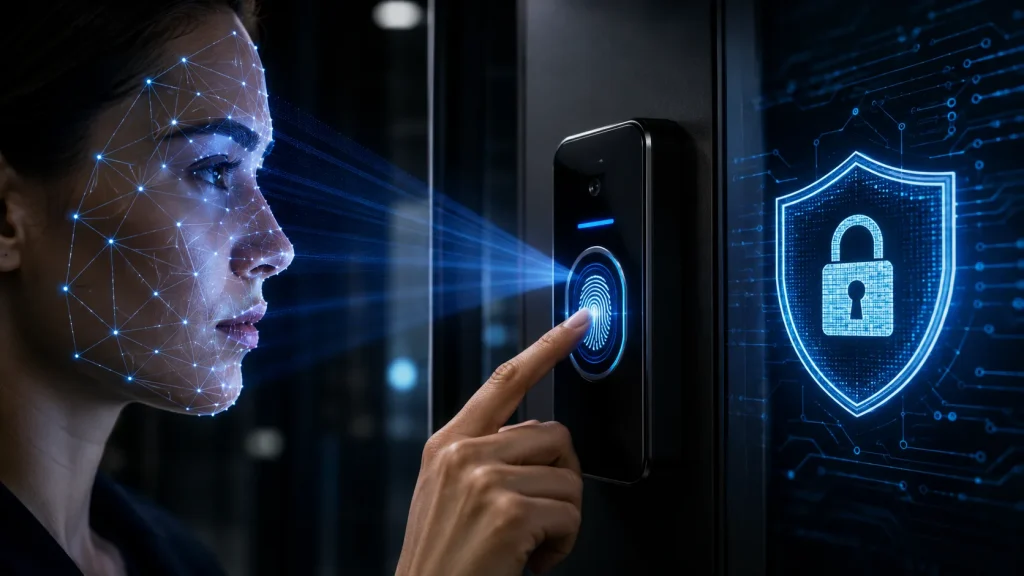
Biometric authentication relies on unique biological characteristics to verify an identity. Rather than matching a typed string of text and numeric characters, a biometric system captures an analog physical trait, converts it into digital data, and compares it against an encrypted template.
However, you might now wonder how this data will remain secure from cracking attacks and prevent unauthorized access? The answer likes in modern security architectures which deploy multiple features such as:
Physiological Biometrics:
These map fixed physical structures. For example, “Fingerprint scanners” read miniature points (ridge endings and bifurcations). “Facial recognition” uses deep learning to measure relative distances between facial landmarks (nose bridge, jawline, eye spacing). High-security sectors also deploy “Iris Scanning”, which maps the intricate, unalterable patterns of the colored ring around the pupil.Behavioral Biometrics:
This layer analyzes the way you interact with technology. It tracks your typing cadence (such as keystroke dynamics), the specific arc of your cursor movement, your device-holding angle, and even the touch pressure applied to a screen.
A security lock focusing on the biometrics, or on a combination of passwords involving biometrics, clearly offers efficient security measures making it one of the most resistant solutions out there.
The Impact of Artificially Intelligent Attacks Such as Deepfakes on Biometric Authentication
The security landscape has shifted dramatically where artificial intelligence generates combinations for bruteforcing and assists in attacks if accessed by malicious people. A similar impact is now seen with biometric authentication. According to the Entrust Identity Fraud Report, approximately 1 in 5 biometric fraud attempts now involves sophisticated deepface or deepfake manipulation.
Because cybercriminals can generate synthetic media or launch “injection attacks” where fake data is directly intercepted and fed into a system’s API, biometric defense mechanisms also have to rapidly evolve.
Older Systems vs Modern Systems using AI:
Older systems used active liveness detection, requiring you to blink, smile, or turn your head to prove you weren’t holding up a photograph. Today, intelligent bots can easily bypass these prompts. Interestingly, the more robust version of security in biometric authentication includes running invisibly in the background, advanced algorithms analyze micro-movements, skin translucency, light refection patterns, and 3D depth to ensure a real flesh-and-blood human is physically present.
The Jump to FIDO2 and Passkeys:
The industry is moving entirely away from passwords and vulnerable SMS one-time codes. Through the FIDO Alliance framework, biometrics are being paired with public-key cryptography via Passkeys. In this scenario, your device acts as a hardware token; when you authenticate via your face or fingerprint, your device releases a secure cryptographic key to the application without ever transmitting your raw biometric data over the internet.
Continuous Authentication:
Instead of a single and static login check, modern zero-trust network architectures now practice continuous identity validation. If a user logs into a sensitive server, behavioral biometrics quietly monitor their typing style and mouse tracks. If the behavior deviates from the established metrics of the usual behaviour, the system automatically steps up authentication requirements from time to time.
For the modern generation, the rise of advanced biometrics hits incredibly close to home. The more they adopt, the more they live at the intersection of extreme digital convenience and heightened privacy risks. Many people use biometrics daily to unlock phones, enter their college or offices, access sensitive portals, and work in an entirely paperless format for sensitive actions such as payments and data transfer. While it eliminates the risk of forgotten authentication ID cards or passwords, the matter becomes more concerning from the data privacy and surveillance perspective.
The Privacy Concerns with Biometric Authentication:
Unlike a password, if your biometric template is compromised, you cannot simply reset your face or change your fingerprint. People must understand the underlying tech architecture and consequences if something goes wrong. Many reputable systems do not store raw images of your face or eye; they store a one-way mathematical hash. Even if the database is breached, attackers cannot reverse-engineer that hash back into a usable visual image.
Biometrics for Identity Authentication: Staying Safe in 2026
Whether you are a student submitting assignments, a working professional accessing corporate servers, a parent managing family finances, or a senior citizen checking retirement benefits passwords alone can no longer protect us. However, that doesn’t mean biometrics is entirely safe, let’s understand a recent threat that attacked this avenue of technology.
In the modern recruitment scenario, the FBI recently uncovered coordinated operations where fake IT candidates used real-time generative video and voice deepfakes to pass video job interviews. Once hired remotely at over 100 Western tech companies, these individuals extracted insider company data and funneled millions into illicit operations.
The Mechanism of the Attack:
Instead of trying to trick a physical lens, attackers deploy “Camera Injection Attacks” where,
- Cybercriminals use modified software or rooted mobile devices, attackers hook into the verification app’s internal code.
- They can also feed an AI-generated, real-time deepfake stream such as a face swap or synthetic identity directly into the application’s video feed pipeline.
- When the app prompts the user to “turn left” or “blink,” generative AI models adapt the synthetic face in real time, executing the exact micro-movements requested.
What This Means for Everyone Who Use Biometric Authentication:
- If you are a student enthusiastic about gaming, social media, and crypto accounts, avoid using cheap face-unlock on budget phones, as it can often be fooled by simple 2D photos or screen replays.
- For working professionals who regularly access corporate funds and email access, beware as scammers using AI-morphed content in video calls to trick staff into transferring company money.
- For adults and senior citizens regularly accessing various apps in banking and insurances that require video verification in KYC, stay extremely cautious with fake banking verification calls or app pop-ups asking you to “look into the camera to confirm your ID.”
Securing the Future with Biometric Authentication
Biometrics represent the digital equivalent of a security guard at every door. By anchoring identity authentication directly to the human user rather than a forgettable string of characters, organizations can systematically block unauthorized access to sensitive databases.
As AI threats grow, our defensive measures must grow with them relying on layered, smart, and privacy-respecting biological keys to secure our digital world.

Author Bio: This article has been written by Rishika Desai, a cybersecurity researcher and threat intelligence professional currently working as a Threat Researcher at BforeAI. She also founded RishSec, a creator-led cybersecurity training and mentoring service that helps aspiring security professionals build practical skills and advance their careers.
Rishika is a B.Tech Computer Engineering graduate from Vishwakarma Institute of Information Technology (VIIT), Pune, graduating with a 9.57 CGPA. She has spoken at international cybersecurity conferences in Singapore and Malaysia, was honored with the Rising Star of the Year award by BSides Bangalore, and was recognized among the Top 100 Cybersecurity Influencers by the CF100 Club CyberFrat.
You can follow Rishika on X (Twitter) at @ich_rish99 and on Instagram at @rish.sec.