
Financial institutions used to measure innovation in years. A new core banking module or a fraud detection upgrade took its own budget cycle, and its own risk committee signed off. That pace does not really match customer expectations anymore, not even close. Account holders want instant approvals, real-time fraud alerts, and personalized advice pushed straight through an app they already trust for almost everything in their financial life.
The mismatch between what legacy systems manage to deliver and what modern users demand is exactly where emerging technology is rewriting fintech. Organizations are getting more focused on fintech software development services to modernize old infrastructure, speed up digital change, and create dependable financial platforms that can shift with customer expectations while still protecting compliance and performance.
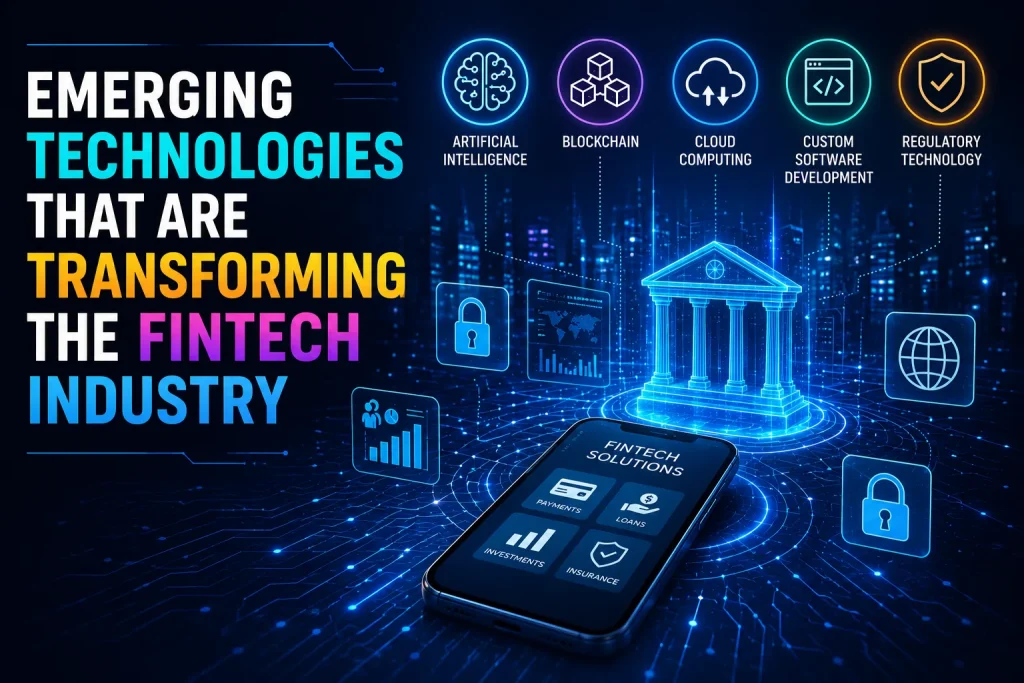
Quick Summary: What’s Reshaping Fintech Right Now
- Artificial intelligence is shifting fraud detection, credit scoring, and customer service from reactive mode into predictive mode.
- Blockchain is shortening settlement times and adding transparency to transactions that once depended on trust alone.
- Cloud infrastructure is giving financial firms the elasticity to launch products without provisioning hardware for peak load.
- Custom fintech software development is tying these capabilities together into offerings that actually fit the business, instead of making the business squeeze itself into a generic platform.
- Regulatory technology is also getting up to speed, so institutions can adopt new tools without somehow drifting out of compliance.
Artificial Intelligence is Becoming the Nervous System of Fintech
AI pretty much moved past simple chatbots and the basic automation stuff. Now, machine learning models show up inside credit underwriting, transaction monitoring, and portfolio management, learning patterns that a rules-based system wouldn’t even notice, not really. Fraud detection is the clearest case in point. Old school systems usually flag transactions using fixed thresholds, so fraudsters just adapt; they learn where the line is and stay under it. AI models, by contrast, absorb behavioral patterns across thousands of variables, catching anomalies that a static rule never would, and yeah, that sounds obvious, but it matters a lot.
Personalization is the other big shift. Wealth management platforms use predictive analytics to suggest small portfolio adjustments before a client even asks, and lending platforms lean on natural language processing to interpret unstructured documents in seconds. None of this truly replaces human judgment, but it shortens the time between a signal showing up and a decision getting made, like a lot, too fast for most manual workflows to keep up.
Blockchain is Quietly Fixing Trust Problems
Blockchain also got an early reputation, mostly linked to cryptocurrency speculation, which kind of muddied its more practical role in financial infrastructure. Distributed ledger technology actually targets a problem the industry has had forever: several parties need to agree on the transaction state without one institution acting as the only referee, or the sole authority.
Cross-border payments illustrate this well. A wire transfer that once took three to five business days, passing through several correspondent banks, can now settle in minutes with a transparent audit trail at every step. Trade finance and identity verification are following the same pattern, replacing paperwork and reconciliation with a shared, tamper-resistant record. The intermediaries being removed are the ones that existed purely to verify what a ledger can now confirm on its own.
Cloud Infrastructure Gives Fintech Its Flexibility
None of this innovation scales without infrastructure that can flex with it. Cloud computing permitted financial firms to stop thinking in terms of fixed capacity. A lending platform that sees a spike in applications during a rate change no longer needs to over-provision servers year-round just to survive a few weeks of peak traffic.
Cloud-native architecture also shortens the distance between an idea and a shipped feature, letting institutions test a product with a subset of users and expand or kill it within weeks rather than quarters. Security has caught up as well. Major providers now offer compliance certifications built specifically for regulated industries, removing one of the last real objections to migrating core workloads off-premises.
Custom Fintech Software Development Ties It Together
AI, blockchain, and cloud are powerful on their own, but they seldom deliver real value when they’re standing alone. The organizations seeing actual returns are building custom software that stitches these technologies into their particular workflows, customer base, and regulatory reality. Off-the-shelf platforms handle generic needs pretty well, but they tend to fall apart when you get into the underwriting logic, the compliance reporting format, or the legacy integration that makes one bank feel different from the next.
This is where fintech software development services earn their place. A partner familiar with financial regulation and system architecture can build a product that reflects how an institution actually operates, rather than forcing internal processes to bend around a vendor’s roadmap.
| Technology | Primary Business Impact | Common Use Cases |
|---|---|---|
| Artificial Intelligence | Faster, more accurate decisioning | Fraud detection, credit scoring |
| Blockchain | Transparency and settlement speed | Cross-border payments, trade finance |
| Cloud Computing | Scalability without capital risk | Product launches, peak load handling |
| Custom Software Development | Tailored integration across systems | Core banking modernization |
Frequently Asked Questions
Q. Is blockchain still relevant to fintech outside of cryptocurrency?
A. Yes. Financial institutions are applying distributed ledger technology to payments, trade settlement, and identity verification, where transparency and faster reconciliation create measurable savings. Institutions exploring blockchain today are usually focused on infrastructure efficiency rather than digital assets.
Q. How is AI different from the automation fintech companies already use?
A. Traditional automation follows fixed rules, executing the same action every time a condition is met. AI models learn from data and adjust as patterns change, which makes them more effective at catching fraud or evaluating credit risk. Static rules become outdated the moment bad actors learn to work around them.
Q. Does moving to the cloud create new security risks for financial firms?
A. It shifts the security model rather than increasing risk outright. Major providers now maintain certifications built for regulated industries, and many firms find cloud environments easier to monitor than aging on-premises systems. Real risk usually comes from poor configuration during migration, not the cloud itself.
Q. Why would a company build custom fintech software instead of buying an existing platform?
A. Off-the-shelf platforms tend to be made for the “average” scenario, not for a single institution’s regulatory obligations or its older, legacy systems. Custom development gives the business a chance to weave AI, blockchain, or cloud tools into how they already operate, not just slap them on top.
Q. What should a fintech company evaluate before adopting new technology?
A. Begin with the business problem, not the technology itself. A firm should look at data readiness, the regulatory implications, and the internal capability they have for maintaining what gets built. When technology is adopted before this groundwork is laid, it often produces more operational debt than it actually removes.
Turning Emerging Technologies into Sustainable Fintech Growth
The fintech companies that are pulling ahead are usually not running after every new technology that enters the market. They view AI, blockchain, and cloud infrastructure as practical building blocks for one specific business outcome, and then they invest in fintech software development services to connect those technologies into secure, scalable, and high-performing financial solutions.
This approach turns technology adoption into a competitive advantage instead of a compliance exercise. The institutions that get this right will not only keep pace with digital-first competitors. They will define the standards that others work to achieve in the years ahead.