
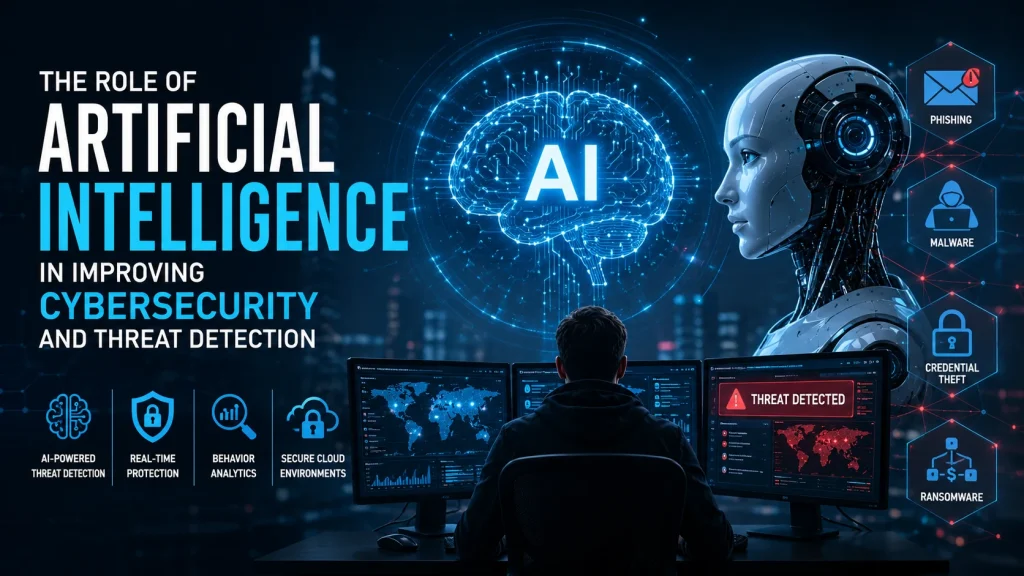
The realm of advanced communication has undergone a complete revolution due to the advent of digital technologies. With the rise of connected devices, the usage of online channels has increased considerably, resulting in the exponential growth of data and information stored and shared online. The effect of such advancement has been the emergence of new possibilities for all the parties involved, but at the same time, it entails new dangers. Cybercriminals constantly improve methods of exploiting weaknesses, which makes cybersecurity an everlasting issue. Consequently, AI is now readily used by specialists to strengthen cyber protection systems, granting them an opportunity to detect threats more swiftly and even analyze large volumes of information.
The increased dependence on digital infrastructure has also influenced the overall cyber security market, whereby companies are more and more implementing smart technologies to boost their protection against new threats. Artificial intelligence plays a significant role in this process, as it enables the processing of huge amounts of information much faster than any manual methods. Since cyber threats continue to change, intelligent systems help experts in the field to detect abnormal behavior, provide better threat detection, and improve responsiveness in a complex digital environment.
Understanding the Role of Artificial Intelligence in Cybersecurity
AI involves computer systems able to perform actions that have traditionally required human-level intelligence, such as pattern identification, the capacity to learn from experience, prediction, and decision assistance. In cybersecurity, AI is used to integrate the technologies used for machine learning, deep learning, natural language processing, and behavioural analytics for the identification of any activity which may represent a security risk. Traditional systems used in cybersecurity are dependent on rule-based methods or the recognition of known attack signatures.
Whilst this is effective, AI can allow for the recognition of even previously unknown or complex attacks by enabling learning from historical as well as current real-time data, allowing it to discern subtle variations in behaviour indicative of activity which can signal potential threats before major compromise takes place.
Rather than seeking out specific known threat signatures, AI learns about patterns between devices, applications, users and networks to gauge a perception of typical behaviour.
Why Modern Threats Require Smarter Detection
The realm of cybersecurity has undergone significant transformations in recent times. Cybercriminals appear to employ contemporary strategies that are more sophisticated than those being used in the past. Modern threats also entail the use of automation, ransomware, phishing campaigns, credential theft, and complicated malware that escapes traditional security protocols.
Traditional security tools generate a great deal of alerts that often require human intervention for verification. Moreover, traditional approaches rely on regular updates and signatures corresponding to attacks, which makes them less efficient when it comes to detecting attacks that have never been seen before. AI overcomes many shortcomings of traditional tools by constantly analyzing data, establishing patterns, and guiding security teams on what incidents to focus on.
How Machine Learning Strengthens Threat Detection
Machine learning provides the basis for several AI-driven cybersecurity technologies. Instead of having to depend on only manual rules, machine learning techniques can examine both past and present data to recognize features of legitimate or illegal activities. As the system keeps learning, it can distinguish regular actions from threats thanks to the increasing amount of processed information.
This capability allows AI to detect atypical login attempts, monitor suspicious traffic, find various malware strains, evaluate emails for phishing processes, and recognize hacked accounts. With machine learning methods working all the time, new kinds of attacks, which are not yet included in classical threat databases, can be detected too.
Detecting Unusual Behaviour Before It Becomes a Serious Problem
A pattern of normal behavior evolves for all your users, devices, and applications. Your staff tends to go into the familiar systems on their standard workday, at their familiar hour, connect to specific software, and talk to familiar employees and partners. Artificial intelligence defines this behavioral pattern for you and monitors your system looking for significant departure from it.
For example, if your user begins to download an abnormally large amount of your confidential data, tries to log in from a new location, or logs in during their off-hours.
It might be indicative of something you should pay closer attention to. None of this behavior directly indicates malice, but it gives valuable signals that assist you in early warning for your insider threats, compromised credentials, or continuing attacks before your company actually gets compromised.
Improving Malware Detection With Intelligent Analysis
The complexity of malicious software has increased markedly; several new variants can alter their code by themselves to avoid the traditional systems of detection based on signatures. This has made it almost impossible for traditional software to identify each new version of a virus.
The advancement of AI has changed the way malware is detected – instead of depending on signatures, AI examines the behavior of software. Rather than simply checking the files against the database, AI understands what activities are performed by malicious software when it is working. AI tracks the files an infected software alters, the files that it is attempting to share with its network, and the files that it is using.
Enhancing Protection Against Phishing Attacks
Phishing remains one of the most successful techniques used by cyber criminals as it relies on manipulating human behavior instead of finding technological vulnerabilities. Fraudulent emails and messages are becoming more and more convincing as time passes, so individuals find it harder to spot the scams.
AI improves phishing detection by looking at different characteristics within communication at the same time, such as the contents, the style of the writing, the reputation of the sender, the content of any links or attachments, and past communications to and from the individual. Natural Language Processing can even tell whether the specific phrasing used within a fraudulent email or message is one of those often seen in fraudulent emails or messages. New methods of phishing will then be identified as new AI models are trained using this data.
Making Sense of Large Volumes of Network Activity
Businesses today produce heavy quantities of network traffic per second. Thus, performing a traditional analysis manually is unproductive and cumbersome. Therefore, artificial intelligence systems act as a constant watchdog of all network processes and report any activity that is notably different from the usual communication patterns, such as unusual activity of various devices, attempts to send sensitive information, or any available indicators that something suspicious might happen.
Thanks to AI’s capability of linking interconnected actions that are taking place in several systems rather than addressing a single event separately, it becomes possible to gain a more comprehensive and complete knowledge about possible attacks. In this way, companies learn about complex attacks that nobody could recognize otherwise and understand them better.
Supporting Faster and More Effective Incident Response
Detecting a cyberattack is only one component of robust cybersecurity. An appropriate and fast response can significantly minimise damage. This is where AI steps in.
It aids faster incident response by analysing security alerts, correlating related incidents, identifying priorities for investigation and automating mundane, time-consuming processes.
While human security professionals continue to make the final decision on how to respond to a cyber attack, the sheer time and effort to gather information and collate the right data for informed decisions are drastically reduced. This allows for better decision-making and effective security response management.
Looking Ahead With Predictive Threat Intelligence
Artificial intelligence technology is being used more widely in predictive threat intelligence. By studying attack history along with the news of new incidents, AI assists companies in eliminating threats before the attack happens. These systems make evaluations of techniques involved in tackling vulnerabilities, developing malware, attackers’ behaviour, and other events in the field of cybersecurity.
Although predictive models cannot guarantee results, they yield beneficial information about how to boost security.
Securing Modern Cloud Environments
Cloud computing is a cornerstone of the contemporary digital environment. With a combination of flexibility and scalability available to organisations of any dimension, it offers a whole range of advantages. The environment it offers is not just more adaptable and scalable than an on-premises one, but it also presents fresh security challenges as the environment is dynamic and, at times, extremely complex in its configurations.
AI complements cloud security with: Constant surveillance of user access, detection of configuration mistakes, identification of malicious activities, identification of unusual usage of resources. Given how rapidly a cloud environment can transform, AI can offer real-time, ongoing analysis to stay up-to-date with the latest configuration changes.
This allows you to achieve superior visibility of your cloud security systems.
Strengthening Identity and Access Protection
Modern threats to networks have made identity one of the key points in cybersecurity efforts since hackers are bent on stealing usernames, passwords, and authentication credentials. Moreover, artificial intelligence enhances identity security by analysing user actions instead of relying solely on passwords and authentication tokens.
Rather than treating every access as equal, AI takes into account the location of login, characteristics of the device, user behaviour, and historical logon activity. This additional level of understanding allows for easier and more efficient detection of breaches.
Understanding the Challenges of AI in Cybersecurity
Although artificial intelligence is very useful, it cannot be the panacea for the security challenges of today. A successful implementation of AI requires reliable data, and it relies entirely on its quality, so inaccurate or incomplete learning data could significantly compromise the detectability of threats or even result in identification errors. Additionally, AI-based systems could also present false identifications that would mark legitimate actions as suspicious activity.
Also, we have to consider the fact that hackers and attackers have started working on ways of trying to fool an artificial intelligence system.
Privacy is also a key consideration since a behavioural analysis requires processing vast amounts of data; the organisation must make sure that it is using AI responsibly and in accordance with privacy legislation in force. Finally, without the experience and knowledge of an information security expert, the results may not be interpreted correctly and contextually.
The Importance of Responsible and Ethical AI
As AI permeates our lives, its increasing use in cybersecurity poses an additional layer of ethical considerations for companies. Companies must ensure that their AI-driven systems comply with people’s privacy, remain transparent in their decision-making processes, and uphold transparency in how security decisions are assisted by the technology. Responsible deployment encompasses proper data handling procedures, AI system performance monitoring, continuous checks for biases, and rigorous governance around the intelligent systems used to further security goals.
The Future of Artificial Intelligence in Cybersecurity
As digital threats are growing and evolving, artificial intelligence is likely to take on more responsibilities in the future. The improvements in this area may include new and more developed behavioural analysis techniques, enhanced automation, improved integration of security systems, as well as the possibility of AI systems cooperating more with humans.
Another piece of good news is that the appearance of generative AI has already started to change the face of cybersecurity for the better, as it can help people analyze threats, create documents, report incidents, and conduct investigations. It should also be noted that cybercriminals may also use the newly developed technologies for their wrongdoings and therefore require a more responsible attitude.
Conclusion
Artificial intelligence plays an increasingly significant role in modern cybersecurity with its enhanced capabilities for detecting threats, facilitating quick replies, and assisting companies in processing large volumes of security information more efficiently. Instead of using only established patterns, AI allows security systems to detect behavior patterns, perform anomaly detection, and be able to react to changing cyber threats.
Even though AI offers huge benefits, it only works properly together with experienced specialists, effective security policies, frequent risk assessments, and continuous awareness programs. As cyber threats are continuously becoming more complicated, the cooperation between human skills and intelligent technologies will still be significant for creating a safer digital world.