
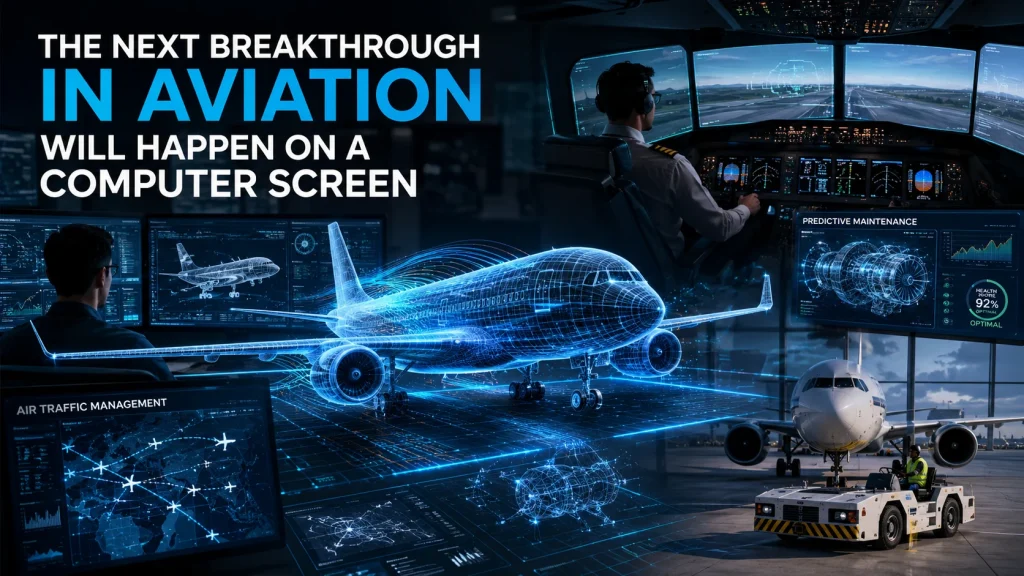
Think about how much of aviation’s future has already taken shape inside digital environments — never touching a physical test bench. That question sits at the center of how the industry now builds aircraft, tightens safety systems, and gets pilots ready for the real thing. Hangars and laboratories haven’t disappeared. But the most consequential breakthroughs? They’re coming off software platforms, modeling suites, and immersive simulations that let engineers push into territory once considered unreachable.
Digital Simulation and Aircraft Design
CAD tools and computational fluid dynamics have rewritten the rules of aircraft conception. Engineers run thousands of design iterations in seconds — wing shapes, fuselage profiles, engine placements — without touching a single rivet. Costs drop. Timelines compress. Digital wind tunnel testing now precedes any physical construction, exposing aerodynamic weaknesses, structural stress points, and fuel efficiency data with striking precision. By the time a prototype actually gets built, it’s already been through exhaustive virtual refinement. What emerges from the factory floor isn’t a first draft. It’s closer to a final one.
Pilot Training and Virtual Reality
Today’s flight simulators bear almost no resemblance to the clunky mechanical boxes of earlier decades. Motion platforms. Wide-field visual displays. AI-driven emergency scenarios. The result is an experience so convincing that pilots can rehearse catastrophic system failures without a shred of actual risk. Major carriers treat these machines as primary certification tools — not supplements. That matters. Practicing a hydraulic failure or a whiteout landing approach in a simulator builds the kind of muscle memory that transfers directly to the cockpit. And scenarios that would be reckless or physically impossible to stage in real flight? Trainees can run them on a Tuesday afternoon.
Predictive Maintenance and System Optimization
AI and machine learning have fundamentally changed fleet maintenance. Sensor data streams in constantly — engine performance, hydraulic pressure, electrical loads, structural readings — and algorithms sift through it, flagging degradation patterns before anything actually breaks. Maintenance teams shift from reactive scrambling to scheduled, proactive repairs. Planes stay safer. Downtime shrinks. Equipment lasts longer. Ground crews working alongside these digital systems still depend on robust physical tools, though. During routine gate turnarounds and repositioning runs, teams rely on durable aircraft pushback tugs to keep aircraft moving safely between maintenance bays — a reminder that even the most data-driven operation has physical demands underneath it.
Air Traffic Management Innovation
Next-generation air traffic systems are being built entirely on screens. These platforms juggle thousands of simultaneous aircraft, trim fuel burn by optimizing routes, and cut congestion-related delays. Developers stress-test them in simulation — normal traffic, severe weather, cascading equipment failures — before a single line of code goes live in controlled airspace. Entire airspace regions get modeled. Traffic patterns years away get rehearsed now. The complexity is staggering, honestly. Only computational systems can handle it, which makes digital development the only sane path forward for testing innovations without endangering anyone.
Emerging Technologies and Future Applications
Electric propulsion. Autonomous flight. Sustainable fuels. All of it is being stress-tested in simulation long before hardware enters the picture. Engineers designing electric aircraft run thousands of virtual experiments on battery thermal behavior and power distribution — solving problems before fabrication begins. Autonomous systems get trained and validated inside AI-driven environments offering essentially limitless test scenarios. What once required years of physical trials now compresses into weeks of computational cycles. Bolder designs become viable. The pace of real innovation accelerates because digital development cycles have replaced the slow grind of purely physical ones.
Conclusion
The aviation industry’s center of gravity has shifted. Computer screens are now the primary workspace — where engineers, designers, and researchers do the work that actually moves things forward. Aircraft design, pilot training, fleet maintenance, air traffic coordination: digital innovation leads, and physical implementation follows. The next major leap in safety, efficiency, or capability will almost certainly emerge from simulation, modeling, or AI developed entirely in a digital environment. Computational power has simply become more valuable than traditional prototyping. And as that gap between digital innovation and physical reality continues to close, computer-based development stops being merely important — it becomes the whole game.