
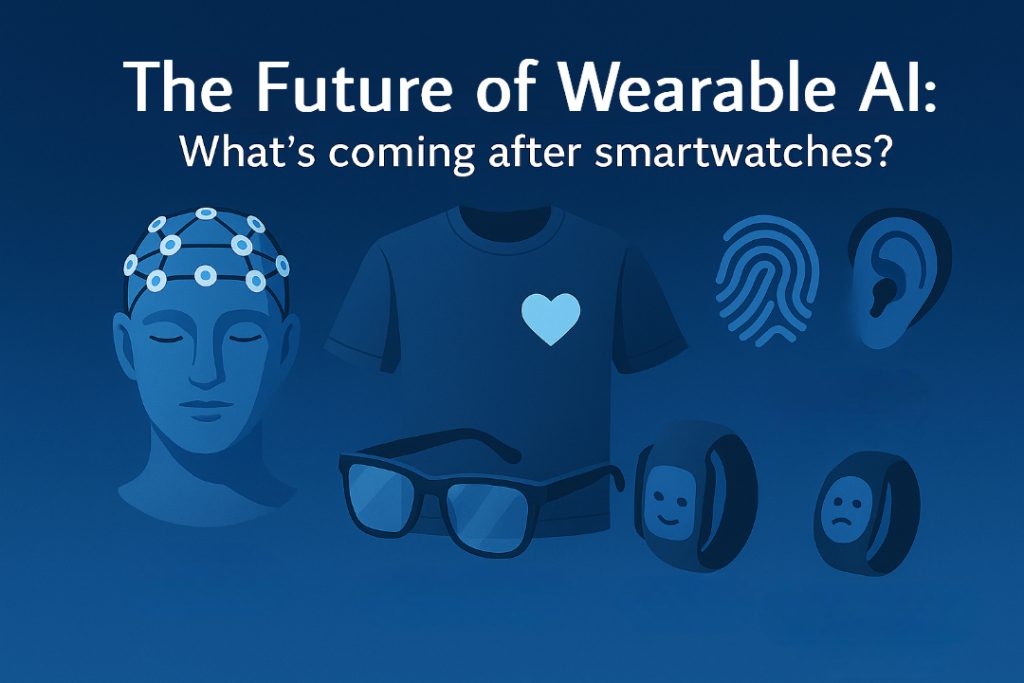
Wearable AI is not only about what is on your wrist anymore. The types of wearable tech are evolving beyond the smartwatch: the next generation of wearable tech can be biometric wearable, neural interface or a combination of both that will redefine how we interact with our gadgets, ourselves, and even our environments. Such AI-enabled tools are heading towards discretion, intelligence, and emotional awareness, and there is a new sense of personalization and convenience. Brain-related devices, AI-powered wearables, and other innovations, such as smart clothing, should not be spoken of as futuristic ideas but become available nowadays and evolve at a fast pace toward the mainstream solutions. With both industries spending billions of dollars to this technological transition, the user will hopefully see their devices to better integrate into their lives, not as tools at our disposal, but as smart systems we are in partnership with.
This future will utilize wearable AI to know when to talk, when to listen, and when to do something which will change not only how we live, but how we feel, how we work, and how we think.
Smart Clothing and Seamless Integration with Everyday Wear
The era of AI-powered clothes has come. Smart clothing is no longer limited only to specialized sports wear; it is venturing into everyday fashion and professional application. Fused into biometrics, they can monitor breathing, body temperature, muscle twitches, etc. Plus, the wearer will not have to wear an independent device such as a smartwatch.
The difference between smart clothing and smart apparel is that it views a whole human body. Unlike a wristband that only measures a single area of the body, these AI garments provide an overall picture on the workings of the body and physical performance and health. They are particularly common among sportsmen, physiotherapists and older bothers because they need a constant checkup without a lot of intrusion.
Manufacturers are pouring in a lot of money to ensure that these clothes are stylish, can be washed and are durable. Engineers are being joined by designers to develop garments that look like normal clothes but respond continuously, with the help of AI, to assist with feedback. Since the technology is continuing to develop and become less expensive one can easily expect to have such things as business shirts that monitor stress levels or socks that remind the diabetic user of a pressure change, and this quality of life improvement can be done without everyone noticing.
Even the repair services such as Apple Watch repair, will have to adjust to this change, as they are going to have to deal with and service the wearable smart clothes that can become the new norm in the AI-augmenting personal devices.
Neural Interfaces and Mind-Driven Devices
It may sound something like this: You are able to manage your devices with your thought. Neural interfaces (they are also called brain-computer interfaces (BCIs)) are making that imagination real. These technologies are able to establish a direct form of communication between your brain and digital ecosystem and eliminate all other physical means of interaction such as typing or tapping.
They are already testing implantable chips that would enable a user to control cursors, keyboards and even robotic limbs via neural signals, and companies such as Neuralink are already trying out the technology. Although the applications are mainly focused on handicapped people, the commercial applications become visible. BCI could be used in the future so that users could just send a message, play the game or scroll the newsfeeds by mind.
Non-invasive possibilities, headbands and helmets are also becoming more and more advanced, interpreting a brainwave activity with AI. They are experimented within terms of being able to track attention of the devices, emotional analysis, and even sleep optimization. Wearable AI could read you before you know it by knowing how the brain says you feel or want or need something by being able to interpret the complicated brain signals that machine learning technologies get more and more able to read too.
However this future is not in any way devoid of questions. The privacy of data, manipulation of thoughts and monitoring of feelings are some of the ethical issues which will require consideration before neural wearables become as normal as smartphones.
Smart Glasses and Augmented Reality Fusion
The so-called smart glasses have been hyped up as the next big thing forever, and maybe AI will be the shot in the arm they are in need of. In contrast to the earlier technologies that only relied on visual input, modern smart glasses integrate camera sensors, and AI processors with real-time data overlays to provide the user with augmented experiences.
You can also follow your path on a street with a visual reminder of the restaurants near you or follow your trail in a building with in-building directions or get a translation in real-life when someone is giving you a speech in a foreign language. With context-awareness, AI can help achieve smart glasses to know what you are doing and adapt the feedback accordingly.
Organizations such as Meta, Google, and Xiaomi are in a hurry to perfect the shape of the glasses and their battery life. There is still the possibility of privacy with facial recognition and camera on at all times. However, as AI renders these glasses more instinctive and less unwieldy, their use is set to increase both consumer and corporate levels.
The implementation of smart glasses is evolving quickly as surgeons use them in operation rooms to assist technicians remotely. Their design frees your hands while enriching your line of sight. It is a game-changer; what’s more, it’s one of the most useful developments, even when compared to traditional smartwatches.
Earables and the Rise of Audio AI
Earables, or ear-worn devices,indeed, are a new type of wearable technology that is in demand among active human beings; it is already being rapidly populated with AI. They are not mere earbuds which are wireless, but nowadays they have many other functions that include biometric sensors, motion tracking, voice control, and sound alterations depending on the context. Such as, certain higher-end models have the ability to check your heart rate via the ear canal, provide instant translation, or even decrease the background noise automatically based on surroundings. Earables with AI become customized relative to your taste and habits, and as it learns about your preferences and schedule, it becomes a better source of sound and personal assistant services.
The current voice assistants, such as Siri, Google Assistant, and Alexa already put the voice assistant at the core of these gadgets, and the future version is going beyond that, monitoring the level of cognitive workload, detecting emotional tones, and anticipating such needs with proactive suggestions based on the situational awareness.
Earables might also become the AI companion of choice and most likely will be used by multitaskers and remote workers as they are discreet and stay on all the time. Technical advancements yield an ear technology that will blur the boundary between people talking and the computers engaged in online communication.
Biometric Implants for Continuous Health Monitoring
Implants are also an ideal way of fixing people with chronic health problems or who want continuous bio-tracking. The latter are the devices that are implanted under the skin and are able to track the level of blood glucose, hydration, pH, and other indicators in real-time thus not involving any user interaction operations.
Unlike wearable wristbands or rings, biometric implants can give continuous data recording. This would be of great use to people living with or who are diabetic, have heart diseases, or even mentally sound. When attached to AI platforms, such implants will be able to identify health deviations and notify both the user and healthcare specialists.
There are already some models that will automatically administer medication or stimulate some nerves using a predictive insight. The early intervention and prevention implications are gigantic. The major challenge will be ensuring these systems have data security, user agency, and opt-out paths at all layers.
This leap in terms of biotechnology and artificial intelligence has brought about the biometric implant, which is shaping a new concept of being proactive on health. With increased awareness, the services such as electronics repair could be developed to offer diagnostic and up-to-date firmware services of implants, demonstrating how the repair ecosystem will keep pace with technology.
Haptic Wearables for Tactile Feedback
Haptic technology involves transmission of information by use of touch sensation either through vibrations, pressure or a change in temperature. Being a built-in solution on AI wearable devices, this technology allows users to receive subconscious alerts and feedback and not be forced to look at the screen.
As such, an example is the one where a cycler may feel a slight tap on the left shoulder by their smart vest when the individual should turn left, or a runner may feel a pulsating vibration in response to the need to ease down on the road when heart rate increases. AI makes these signals relatable, individual and non-obtrusive.
VR and gaming wearable gloves are also experiencing massive development, where people can experience digital environments by touch, feeling the surfaces and pressure. Beyond entertainment, haptics is making the blind broach working in the city by relying on AI-made audio hints delivered through touch.
Conceptually this may be possible as any wearable AI technology introduced in the future gains a haptic layer as haptic technology becomes more precise and affordable, making it a likely feature of all types of wearable AI—a private, sensory-based dialogue between humans and the gadgets they utilize.
Emotion-Aware Wearables for Mental Health
Wearable AI is starting to fill that gap as mental wellness is being considered just as important to maintaining a healthy life as physical health is getting attention. Tracking the stress level, mood swings, sleep patterns, and even facial micro-expressions to measure emotional states in real-time is today possible with the devices.
Your behavioral and biometric data gets analyzed with the help of AI, and these wearables can give you recommendations on how to enhance your mental health too, be that a soothing playlist, a guided meditation, or a reminder that you should get a break. Others even become connected to mental care apps to help them even more individually.
Each of these emotion-sensitive wearables is unobtrusive, usually in form of rings, necklace or wrist bands, and becomes part of the daily routine. They are making it easier to speak openly about mental health and equipping users with a means of self-discovery and self-management.
Once these devices become advanced, AI will also feel more comfortable reading not only data, but context, differentiating between work stress, social anxiety and other stimuli to provide more specific reactive behavior.
Sustainability and Repair in Wearable AI
With the wearable tech industry entering the maturity stage, the notion of sustainability has taken centre stage. Customers desire products with a longer life, can be easily fixed and that are eco-friendly.
There is growing popularity in modular wearables, where parts of the device can be changed or upgraded separately, such as the battery, a sensor, or the display. This design philosophy urges users not to discard their devices but to repair them thus lowering the production of electronic waste to a great extent.
In order to facilitate the trend, specialised companies, such as electronics repair stores are specifically providing repair and upgrading services for wearable technology. Besides replacing cracked displays or dead batteries, such shops will assist with software upgrades and troubleshooting, so that the owners of AI-powered gadgets will be capable of making their products last longer at a reasonable cost.
With increased awareness, businesses will need to embrace the concept of sustainable design, which involves using biodegradable materials, ensuring the recyclability of electronic products, and establishing a robust repair system. The win-win situation is that users save some money, and the planet can breathe a little bit.
Final Thoughts: From Wrist to World—Wearable AI Goes Everywhere
The wearable revolution has started with smartwatches, but the future is with gadgets that become invisible in our garments, our heads and even our skin. AI revolution is not only about computing technology but about integration. Wearable AI will transform our comprehension of ourselves and the surrounding environment and will make us more intelligent, reactive and highly human.
As ever-growing knowledge in AI, sensor technology, and user experience is combined, it brings us into a future where our devices will not likely be tools only, but rather collaborators. Not only could you be monitoring your heart rate via a shirt, do a translation of a conversation through smart glasses or get some emotional support by way of a discrete AI ring but wearable technology is about to get incredibly personal.