
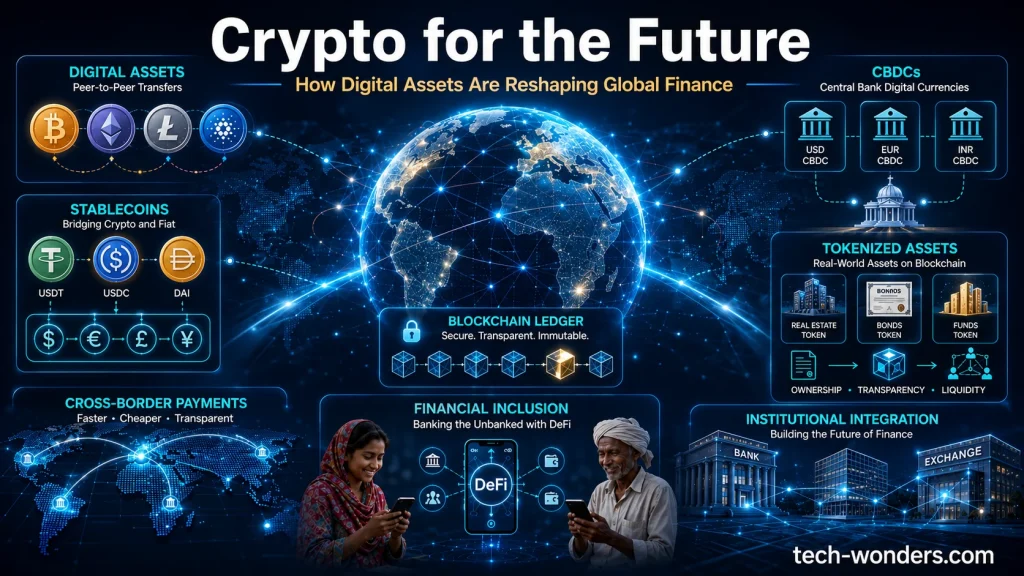
While digital assets started as a niche experiment, the past decade has seen them evolve from a niche experiment into a major force in global finance. Nowadays, governments are actively exploring the idea of central bank digital currencies. In addition, multinationals are embracing blockchain-based settlement systems, and institutional investors are now considering digital assets as a distinct asset class.
Talking about crypto for the future, it is no longer simply about speculative trading. Instead, it’s about rethinking the transfer, storage, and representation of value in a digitally connected economy.
A deeper look at “crypto for the future”
Typically, people’s discussions about “crypto for the future” have focused on rising prices or new tokens. However, a broader and more useful definition considers the financial infrastructure built on programmable digital representations of value.
These assets can include:
- Cryptocurrencies– These are used for peer-to-peer transfers.
- Tokenized assets– These include digital representations of bonds, funds, or real estate interests.
- Stablecoins– They are designed to track fiat currencies.
- Central bank digital currencies (CBDCs)– Many jurisdictions are studying and piloting CBDCs.
The common thing linking all of these is that ownership and transfer can be recorded on a blockchain or similar distributed ledgers. This paves the way for the verification and settlement of transactions digitally.
More than ever before, major financial institutions like the Bank for International Settlements have been looking into how these systems could improve efficiency and cross-border settlement.
Quicker and cheaper global payments
For many years, users and other interested parties have been criticizing cross-border payments for being slow, expensive, and fragmented. The conventional international transfer processes involve multiple intermediaries, each increasing cost and processing time.
A key aim of blockchain-based payment networks is to reduce that friction. The initiation and digital verification of transactions can happen faster than traditional banking flows. Stablecoins, specifically, have gained more attention as they combine blockchain transferability with a value reference tied to established currencies.
To pave the way to the use of stablecoins, regulators have been focused on consumer protection, anti-money-laundering controls, and financial stability. For instance, the Financial Stability Board and International Monetary Fund both emphasize the need for stablecoins and other digital assets to have an appropriate regulatory framework before these assets can operate at a large scale.
Helping the unbanked populations to get banked
One of the compelling arguments for crypto for the future is not so much around the trading volumes of major exchanges. Instead, it’s about the populations that the traditional finance world has historically excluded. Some statistics put a rough estimate of 1.4 billion adults worldwide as being unbanked, meaning they lack access to the most basic savings or lending products.
Fortunately, decentralized finance (DeFi) comes to the rescue of such underserved populations. DeFi allows anyone with a smartphone and an internet connection to lend, borrow, earn returns, and exchange assets with no intermediaries.
Thanks to projects built at the intersection of accessibility and blockchain technology, banking for the unbanked is now tangible. Platforms like flpp.io are examples of a growing list of ventures aimed at bridging everyday users to decentralized financial tools. They reduce friction, improve transparency, and put financial autonomy directly into the hands of individuals rather than institutions.
Tokenization to turn real-world assets into digital ones
Another significant point around crypto for the future is asset tokenization. Instead of representing asset ownership through paper certificates or siloed databases, an asset can be represented by digital tokens on a ledger.
Some benefits of asset tokenization include:
- Fractional ownership– Allows investors to buy smaller portions of high-value assets.
- Lower investment barrier– Reduces in a significant way the capital required to invest.
- Increased liquidity– Eases trading of traditional illiquid assets.
- Enhanced transparency– Facilitates faster settlement and ownership transfers.
- Minimal administrative costs– Automates most of the manual processes.
- Enhanced transparency– Blockchain records show clear transaction histories.
The risks that still matter when considering crypto for the future
While digital assets offer so many promises, they are not a solved problem. Here are some crucial risks to consider:
- Volatility– Many digital currencies experience large price swings.
- Security failures– Hacking of exchanges, smart contract bugs, and custody failures can result in failures.
- Operational complexity– Some users can have challenges managing keys, wallets, and compliance requirements.
- Regulatory uncertainty– Rules vary across countries and continue to evolve.
The above concerns point to why regulators have generally moved towards tight oversight instead of unrestricted adoption.
What to expect in the next decade
As we think about crypto for the future, the most plausible future is not a world where every transaction happens on a public blockchain. The most likely scenario is that there will be a hybrid financial system characterized by the co-existence of traditional institutions, tokenized assets, regulated stablecoins, and CBDCs.
Final thoughts
The discussion about crypto for the future is not so much about replacing finance; it’s more about digitizing and automating the movement of value. When looking at the long-term impact and value of the technology, it will depend less on hype and more on whether it can deliver real-world efficiency, security, and regulatory compliance at scale.